If this sounds familiar, you are not alone. And it is not just a “your data isn’t ready” problem, no matter what the vendor’s customer success team tells you.
Here is what is actually happening.
The Triple Miss
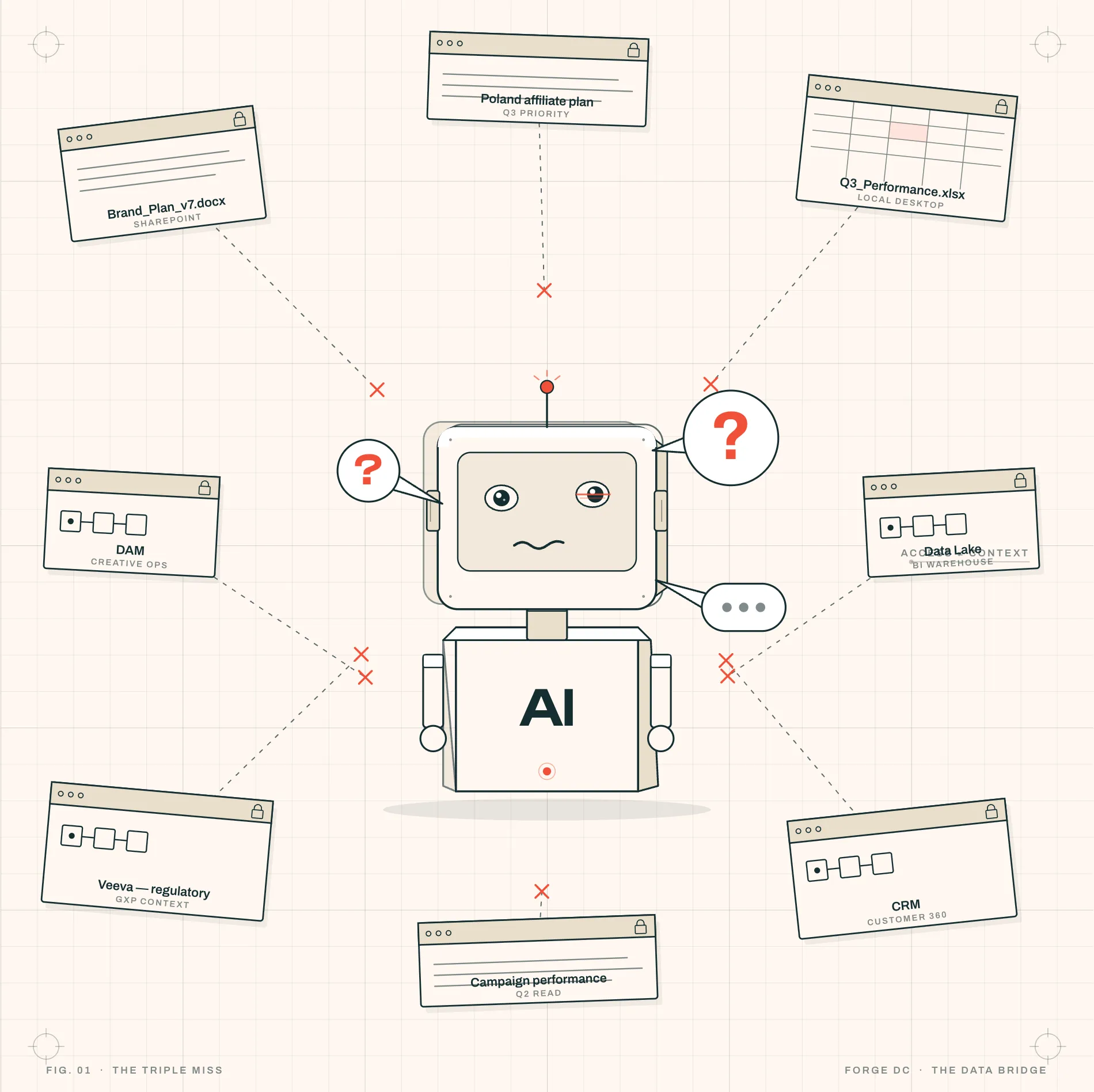
Your shiny new AI-powered DAM, CRM, content platform, analytics tool, pick this quarter’s box, has three problems, and only one of them gets talked about.
First, it does not understand your business. It knows you are a pharma company, or a retailer, or a bank. That is roughly where the understanding ends. It has never seen your brand strategy. It does not know which products are launched, growing, or coming off patent in each market. It cannot tell you what “the Spain Brand X plan” means, because it has no idea you have a Brand X plan for Spain.
Second, it does not understand your other systems. This is the one nobody talks about. Your business runs on twelve, fifteen, and twenty platforms. The AI inside any one of them lives in a sealed room. It cannot find your brand strategy in SharePoint, does not know whether your campaign performance sits in your Data Lake or in an Excel file saved on your media planner’s desktop, and cannot reach the regulatory context in Veeva. Even if the answer the user needs exists somewhere in the company, the AI cannot get to it. And the enterprise-grade tools that do reach across systems, ChatGPT or Claude with full enterprise access, do not solve this. They can reach the brand plan. They cannot tell you which document is “the brand plan”, which version is current, or how it connects to last quarter’s campaign performance. Access is not context.
Third, when it does not know, it makes things up. Not maliciously, that is just what large language models do when you ask them a question they cannot ground. They reach for generic concepts, plausible-sounding patterns from the training data, and confident prose. The vendor calls this “AI assistance”. Your team calls it making it up.
And then the blame game starts.
This is the bit that should make every CIO furious.
When the AI feature underperforms, the vendor blames the data. The data team blames the AI. The business blames procurement for buying it. Procurement blames the business for asking. Everyone agrees there is a “change management problem”, schedules a workshop, and quietly walks away from the rollout.
Nobody owns the missing piece. Because the missing piece is not anyone’s product.
What is actually missing
The thing none of these vendors are selling, the thing they cannot sell, because their incentive is to lock you into their walled garden, is a business memory. A layer that sits above the systems, knows what your business is, knows what each system contains, and knows how to connect the two.
It is the difference between an AI that says “based on general industry trends, you might consider…” and an AI that says “based on the current brand plan, the Spain affiliate’s Q3 priority, and the last three campaign performance reads, here is what I would change.”
One of those is theatre. The other is useful.
If you have rolled out an AI feature this year and quietly turned it off, you are not the problem. You were sold a hallucination.
The fix is not another vendor. It is the layer underneath them all.
Let’s talk
If any of this names something you are wrestling with in your own AI rollouts, we would like to hear about it. Working through specific AI implementation challenges is what we do at Forge DC. Reach out to discuss your challenges.
Next in the series
Over the next few weeks I will go deeper.
Article 2, Every AI project becomes another silo, makes the structural argument explicit and explains why buying AI per department quietly recreates the data silo problem in a more expensive form.
Article 3, Forget more data, you need a memory, is the educational core: what a knowledge layer actually is, in plain English, with no graph theory.
Article 4, One memory, many agents, brings it all together: how DataBridge sits underneath your stack so any AI tool you buy can finally do its job.
Fabio Barboza is CTO and Strategic Partner at Forge DC, where he leads R&D on DataBridge and writes Forge Field Notes. He has spent more than a decade at the intersection of data, technology, and commercial pharma. Based in London.